Shooting the Moon in Hearts: Strategies and Scoring
By Neal Taparia - Published: 02/24/2026
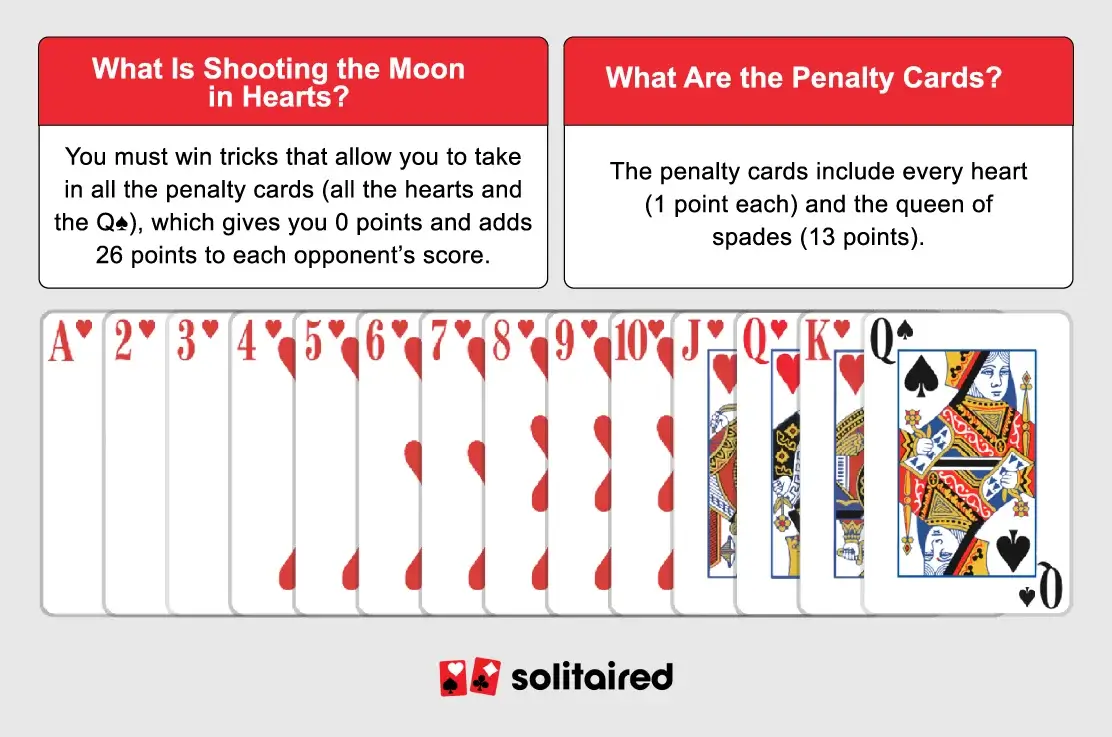
When you play Hearts, shooting the moon is one of the boldest strategies you can take. Instead of avoiding penalty cards, you aim to capture every single one—all the hearts plus the 13-point Q♠.
If you succeed, the score can swing dramatically in your favor, adding 26 points to all opponents while you add nothing to your score. If you miss even one card, though, you’ll pay the price and rake in all the penalty points you’ve accrued.
In Hearts, your ultimate goal is simple: have the lowest score possible by the time a player hits 100 points. Because each heart you take adds 1 point to your score and the Q♠ is worth a hefty 13 points, you typically spend your time ducking those cards. But shooting the moon flips game logic on its head.
If you’re an experienced player, this guide explains how best to use this high-risk, high-reward moon shot move, which can turn the tide of this trick-taking game.
What Are the Rules for Shooting the Moon in Hearts?
Shooting the moon turns the game upside down, because instead of avoiding all the penalty cards, you try to capture them.
The Basic Rules for Hearts
- The game is usually played with four players and a standard 52-card deck.
- At the start of each round, everyone is dealt 13 cards, and players pass three cards before play begins in most rounds.
- Players must follow suit if possible (play a card of the same suit that was led). If they cannot, they may play any card.
- There is no trump suit in Hearts, so the highest card of the suit led always wins the trick.
- The player who won the previous trick leads the next one. The round continues until everyone is out of cards.
- Hearts cannot be led until a heart has been played on another trick (called “breaking hearts”).
- Hands are scored at the end of each round. Each heart taken is worth 1 point, and the Q♠ is worth 13 points.
- The game ends when a player reaches 100 points, and the player with the lowest score wins.
Before you can understand shooting the moon, you need to understand how to play Hearts.
Scoring and Gameplay Rules for Shooting the Moon
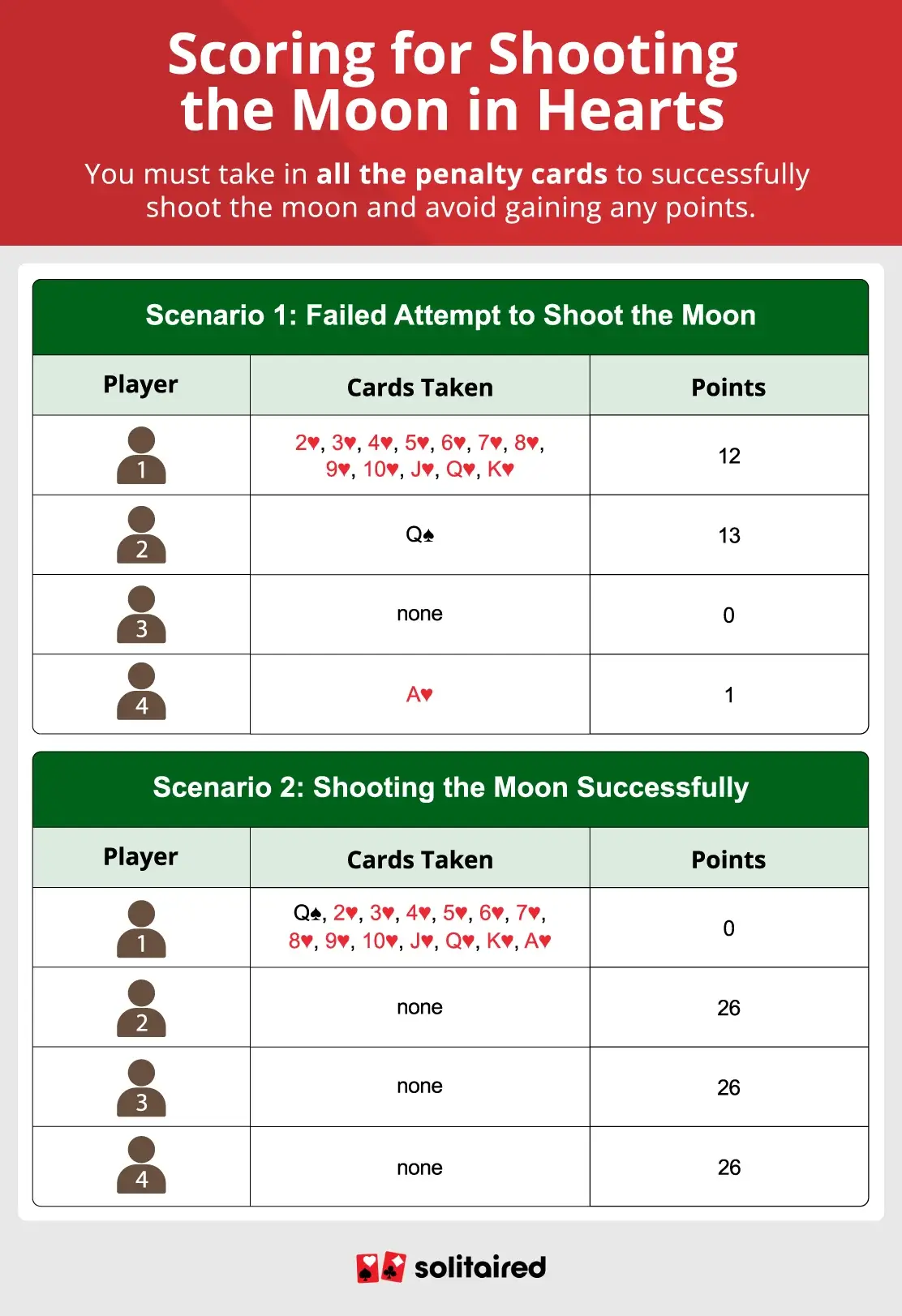
Shooting the moon is like heading into a storm, and it uses just one, straightforward rule: Capture every penalty card in a single round, which includes all 13 hearts and the Q♠ (worth 13 points). But the scoring outcome depends on whether you pull it off or fall short.
| Outcome | Your Score | Opponents' Score |
|---|---|---|
| Success (you capture all 13 hearts + Q♠) | 0 points | +26 points each |
| Failure (you capture some, but not all, penalty cards) | Points equal to the hearts + Q♠ you captured | Points equal to the hearts + Q♠ each opponent captured |
For example: If you capture the Q♠ and 12 heart cards, but another player slips away with the ace of hearts, that opponent only gets 1 point while you’re stuck with 25 points.
This is why shooting the moon is considered an all-or-nothing Hearts strategy. Done right, it can swing the game in your favor instantly. Done wrong, it can bury your score under a mountain of points.
When Should You Try to Shoot the Moon?
The best time to shoot the moon is when your hand gives you the tools to control the round. Because you must win every trick that contains a penalty card, the cards in your hand matter more than anything else.
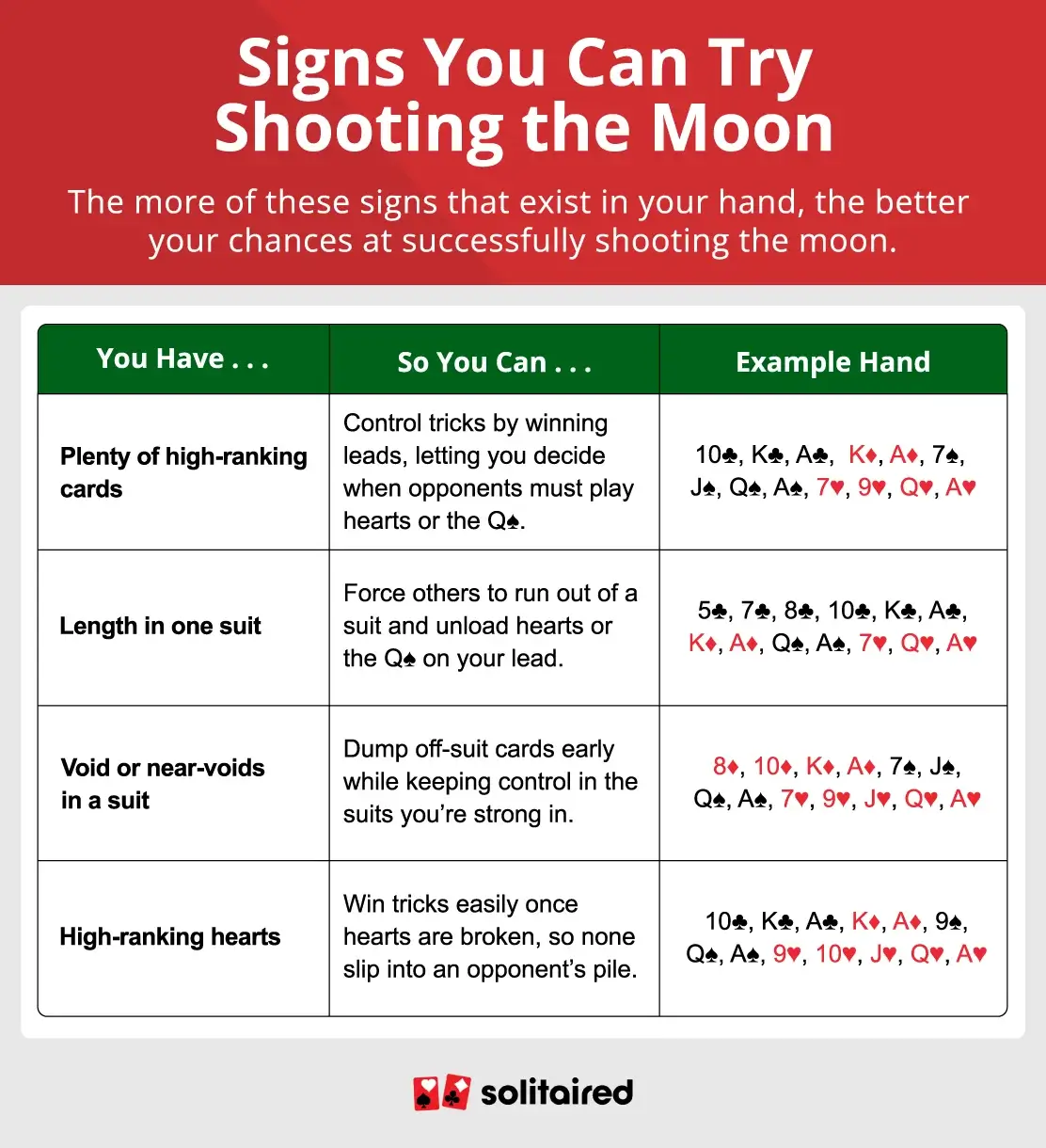
Look for these signs that you might have the right hand:
- Plenty of high cards: Holding the ace, king, or queen in several suits gives you control over who wins each trick.
- Length in one suit: A long run of cards in clubs or diamonds lets you keep leading from that suit until opponents run out, forcing them to play their hearts or the Q♠.
- Strong hearts: Having most of the high hearts (ace, king, queen, jack) makes it easier to sweep in lower-ranking ones once hearts are broken.
- Voids or near-voids: If you’re missing a suit entirely or only have one low card in a suit, you can quickly dump off-suit cards and keep control with the suits you’re strong in.
A hand with several of these features doesn’t guarantee you’ll shoot the moon, but it gives you a realistic chance. If you’re missing them, however, it’s usually smarter to stick with a safer strategy of avoidance.
Strategies for Shooting the Moon
Knowing when to try for a moon shot is one thing and actually pulling it off is another. Because this strategy is all or nothing, you need both the right cards in your hand and the right approach to steer the round in your favor.
Use these key tactics:
- Use the pass to set up your hand. At the start of each round, pass away low cards in short suits (suits you have fewer cards for than others). This increases the chance you’ll run out of that suit quickly, allowing you to snag more hearts or the Q♠ later. If you have the K♦, 6♦, and 3♦, shedding the 3 and 6 and another low card leaves you with a chance to play hearts when other players are shedding hearts after a diamond has led. However, hold on to your high cards, like the king, because they’re your tools for controlling tricks.
- Control the flow of play. Strong high cards in one or two suits let you dictate when to lead and when to pull opponents into giving you penalty cards. Keeping track of what has been played and what is left to be played allows you to time your taking of tricks and leads more precisely. Some players will reserve the A♥ precisely to ruin an opponent’s chance at shooting the moon. So watch as cards play to see if anyone is holding onto it.
- Be ready for hearts to be broken. After hearts are broken (played for the first time), opponents will start unloading them. Keep your gameplay nimble in case someone throws that first heart unexpectedly because you’ll need to have cards ready that can pull in that card unless you’re the one doing the breaking. This is why controlling the flow of play is so important. If an opponent leads the 10♣ and you play a 5♣, you’re sunk if someone following you breaks hearts by playing a 4♥. So control the flow so you can be ready with high hearts to sweep other hearts into your pile instead of letting them slip away.
- Manage the Q♠ wisely. If you’re shooting the moon, you don’t want someone else to dump the queen at the wrong time, like when you’ve already thrown out a low, off-suit card. Keep control of spades until you’re ready to grab her safely. Leading high spades early can backfire if you don’t have enough spades to capture the queen or you don’t have enough off-suit high cards to keep control of the lead.
- Disguise your plan. Skilled players don’t make it obvious they’re shooting the moon. Mix in safe plays at first to avoid attention, then tighten control as you move through the round. A sure sign you’re shooting the moon is playing your highest cards too early. An even more obvious sign is leading the A♠ and K♠ in sequence, trying to capture the Q♠. Finesse and subtlety are your friends when using this advanced strategy!
Pulling off a successful moon shot often comes down to psychology as much as card strength. By masking your intentions and keeping control of the pace, you make it much harder for opponents to stop you.
Different from other types of card games, Hearts gives you a unique strategy to make a major play: shooting the moon. If you’re ready to try this technique or need to practice how to control the flow of the round, play Hearts as often as you like for free on Solitaired.
About the author