How to Play Gin Rummy
The goal of Gin Rummy is to be the first player to reach 100 points by forming melds (sets and runs) and minimizing deadwood (unmatched cards). Players score points by ending a hand with fewer deadwood points than their opponent or by going gin (having zero deadwood).
Gin Rummy Setup
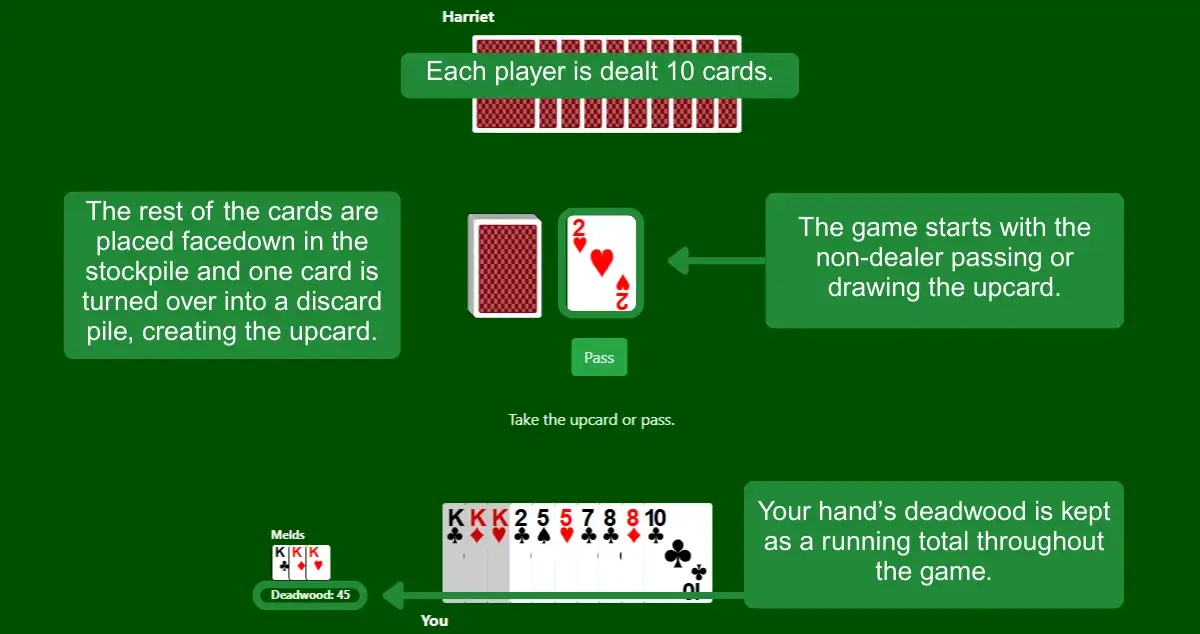
Gin Rummy is a two-player card game played with a standard 52-card deck. Players sit across from each other and are dealt ten cards each. Each round is set up and played as follows:
- Stockpile: After each player is dealt ten cards, the rest are placed into a facedown pile to draw from during the game.
- Upcard: The upcard is turned face up next to the stockpile to start the discard pile. The non-dealer may choose to take the upcard first. If they pass, the dealer may choose to take it. If both players pass, the non-dealer draws from the stock pile to begin play.
- Discard pile: Players must always discard a card on each turn, and the card is placed face up into this pile.
Gin Rummy Terminology
Gin Rummy uses some unique terminology that is helpful to know before you start playing:
- Hand/round: Every deal begins a new hand, also referred to as a round. The round ends when a player goes gin or knocks, and you play as many rounds needed until a player reaches 100 points.
- Deadwood: Any card not included in a meld is considered deadwood. Deadwood points are based on card values and are used to calculate scores. Your deadwood total is continuously calculated during the game.
- Card values: Aces are worth 1 point. Number cards are worth their face value (so a 7♣ is worth 7 points). Face cards (J, Q, K) are worth 10 points.
- Meld: A group of cards (set or run) that reduces deadwood and scores points.
- Set: Three or four cards of the same rank, such as 7♣, 7♦, and 7♥.
- Run: Three or more cards in sequence of the same suit, such as 4♠, 5♠, and 6♠.
- Knock: When your deadwood total is 10 points or less, you can knock to end the hand.
- Gin: If you end the hand with zero deadwood (all cards are part of melds), you go gin, which adds a bonus to your score.

Gin Rummy Rules
- Start play by taking or passing on the upcard. The non-dealer gets the first opportunity to take or pass the upcard, the first card turned over after the deal. If they pass, the dealer gets a chance to take the upcard.
- If either player picks it up, they must discard a card, and then play continues with the next player taking a normal turn.
- If both players pass, the non-dealer draws from the stockpile to begin play.
- Take turns drawing and discarding cards to form melds and reduce deadwood. Each turn consists of drawing one card from either the stockpile or discard and discarding one card so that you always end your turn with ten cards in your hand.
- Form melds using sets or runs to reduce deadwood. A set is three or four cards of the same rank (Q♣, Q♠, Q♥) and a run is three or more cards in sequence of the same suit (5♥, 6♥, 7♥). Melds stay in your hand and are not placed on the table during play.
- End the round by knocking or going gin.
- You may knock to end the hand if your deadwood total is 10 points or fewer. When you knock, both players reveal their hands, and your opponent may lay off deadwood cards onto your melds if possible before the hand is scored.
- You may go gin to end the hand if all of your cards are part of melds and you have zero deadwood. When you go gin, your opponent is not allowed to lay off cards, and you receive a gin bonus in addition to any points scored from your opponent's deadwood.
Gin Rummy Scoring
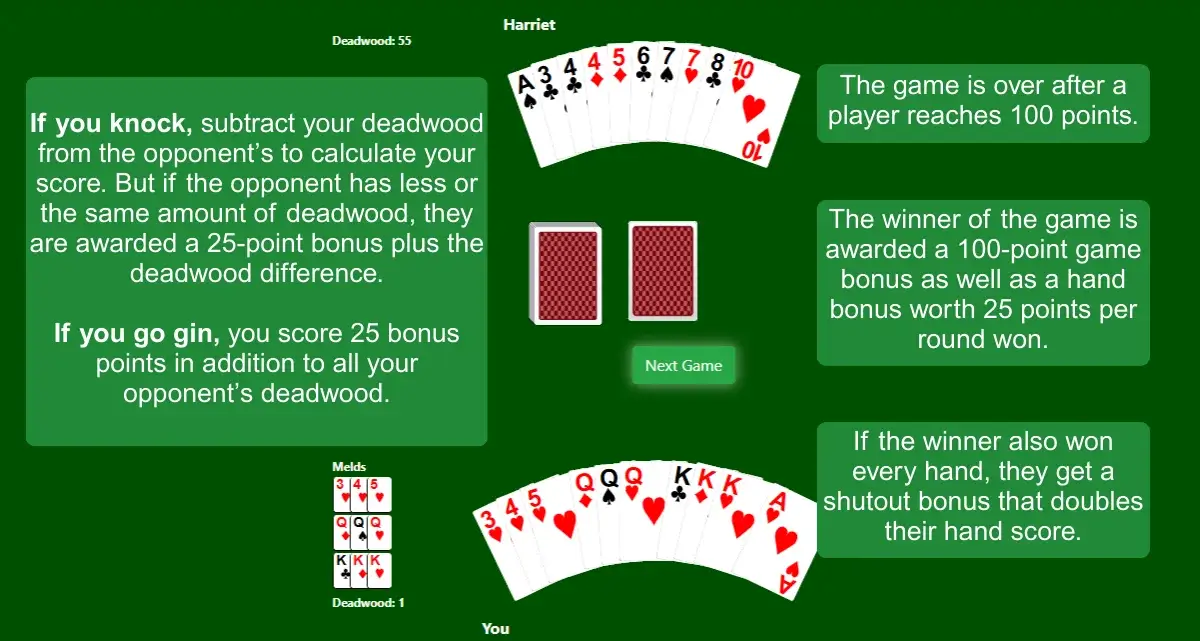
You continue playing hands until a player reaches 100 points. Each hand is scored, and then bonus points are awarded when the game ends, with points calculated as follows:
- Scoring occurs at the end of the round and is calculated with deadwood points and bonus points.
- If you knock and have less deadwood than your opponent: The difference between your opponent's deadwood points and yours is your score. So if your opponent has 21 deadwood points and you have 9, then you score 12 points.
- If you knock but have more deadwood than your opponent—the undercut: If your opponent has less deadwood when you knock, then your opponent not only scores the difference of the deadwood, but they also get a 25-point undercut bonus.
- If you knock and have the same amount of deadwood as your opponent: This is considered a tie, and the opponent is awarded 25 points. You get nothing.
- If you go gin: You get 25 bonus points and your opponent's deadwood points. So if your opponent has 13 deadwood points when you go gin, you get 38 (13 + 25) points for that round.
- Additional bonus points are awarded at the end of the game.
- Game bonus: The winner receives a 100-point bonus added to their score for winning the game.
- Hand bonus: The winner receives an additional bonus of 25 points for each hand (round) won in the game. So if you win the game and have won four of the six rounds played, you get a 200-point bonus.
- Shutout bonus: If the winning player also wins every hand of the game, the shutout bonus doubles their hand score. So if they scored a total of 126 points from all the hands won (including gin bonus points) before any post-game bonuses, they add an additional 126 points for a shutout bonus.
Gin Rummy Strategies
- Reduce deadwood early to improve your hand. Keeping your deadwood low makes it easier to knock safely and limits scores if your opponent goes gin. Discard high-value deadwood cards that are unlikely to form melds, such as face cards and high numbers.
- Build flexible melds instead of committing to a single set or run. Holding cards that can form multiple melds gives you more options as the hand develops and helps prevent high deadwood totals. For example hanging on to a 6♣, 7♣, 7♠, allows you to add in a seven for a set or a 5♣ or 8♣ for a run.
- Be cautious when drawing from the discard pile. Picking up discards reveals information about your hand and melds, while drawing from the stockpile keeps your gin rummy strategy hidden from your opponent.
- Track your opponent's discards and pickups throughout the hand. Watching which cards your opponent avoids or actively takes can help you predict their melds and adjust your strategy accordingly. That way you can avoid discarding cards that help your opponent complete melds or runs.
- Use knocking as a defensive and offensive strategy. Knocking at the right time can stop your opponent from going gin while allowing you to score points from their remaining deadwood.
If you enjoy multiplayer card games, you can also try playing Cribbage or Whist all for free on Solitaired!
