How to Play Whist
The goal of Whist is to be the first team to reach 7 points by winning tricks during each round. Teams score one point for each trick taken beyond six.
Whist Setup and Terminology
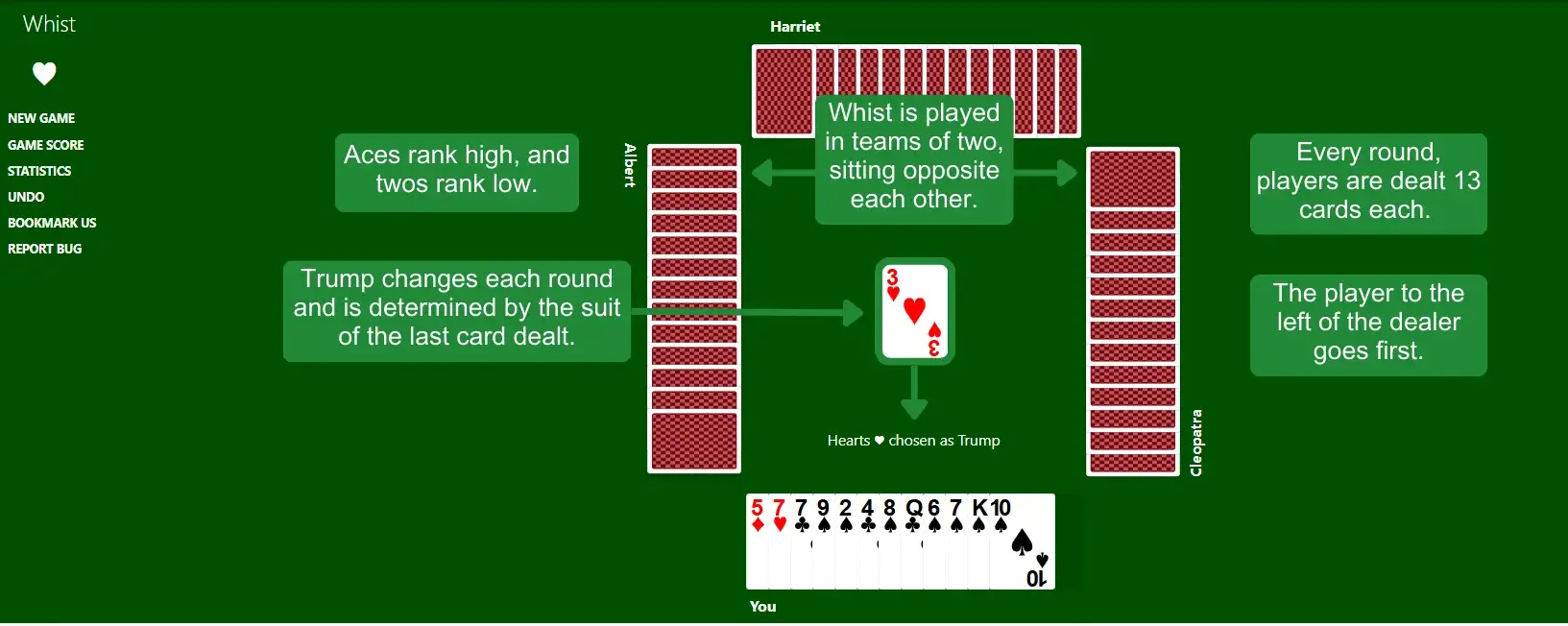
Whist is played with four people split into two teams (partnerships), with teammates seated across from each other. The game uses a standard 52-card deck and follows this setup:
- Dealing: Each player receives 13 cards, so the entire deck is dealt out every round. The player to the left of the dealer goes first.
- Tricks: The game is played in rounds with each team trying to win as many tricks as possible. A trick is created when each player places a single card into the middle during gameplay. Because all cards are dealt out each round, rounds consist of 13 total tricks.
- Card rank: Aces rank high.
- Trump suit: Trump changes each round, based on the suit of the last card dealt, which determines the suit that beats all others. If the last card dealt is a 10♣, then the dealer shows the card to the players, makes clubs trump, and then tucks the card into their hand.
Whist Rules
- The trump suit changes randomly each round. The suit of the last card dealt determines trump. The dealer reveals the card (suit and rank) and then places the card into their hand to be played during that round.
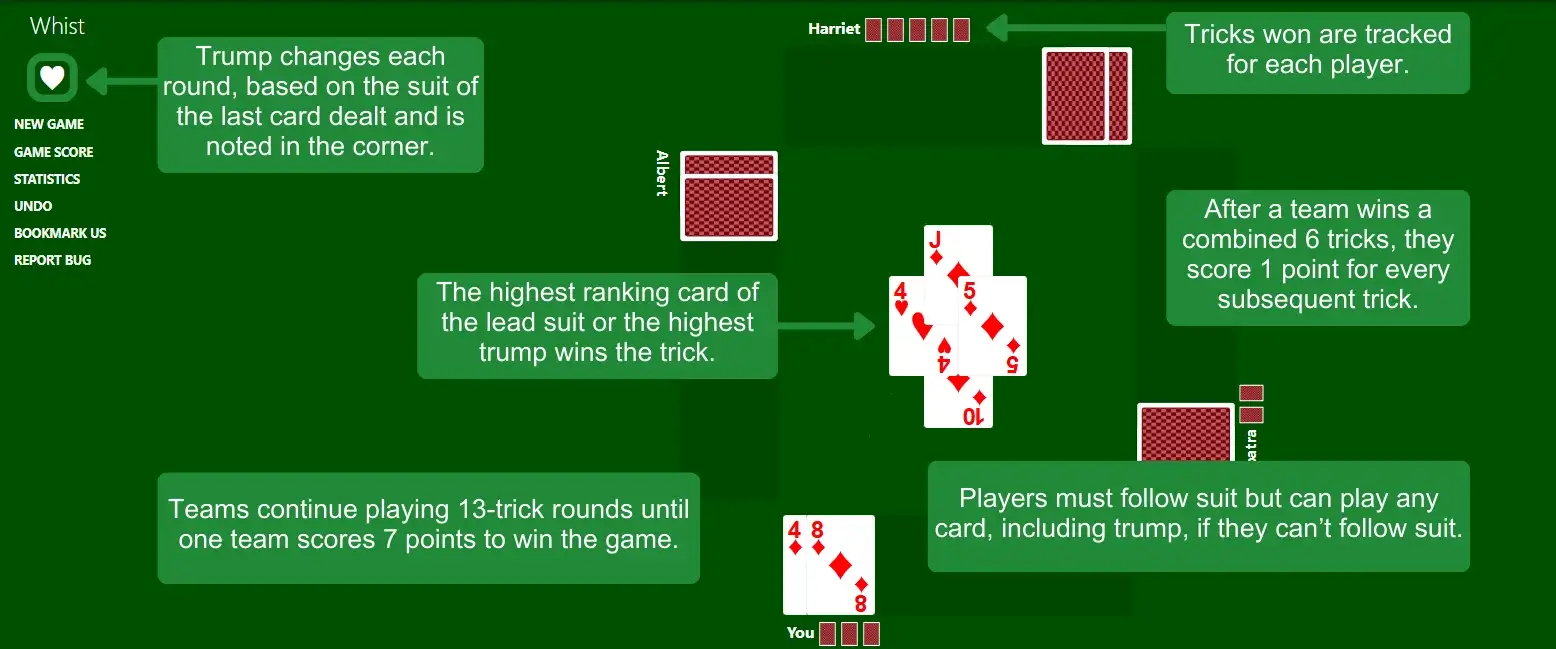
- Play 13 tricks per round. For the first trick, the person to the dealer's left leads any card they choose and play continues clockwise. After the first trick, the player that won the previous trick leads the next one.
- Players must play a card of whatever suit was led for the trick. If they can't follow suit, they can play any other card (including trump). So if hearts led, you have to play a heart, but if you don't have a heart in your hand, you could play a club, spade, or diamond. That means that if you can't follow suit, you could trump and win the trick.
- You win a trick by playing the highest card of the suit that led or the highest trump. So if the cards played in the trick are a J♠, Q♠, 5♠, and 10♠, the Q♠ would win the trick because it was the highest in rank. However, if clubs are trump and the cards played in the trick are J♠, 6♣, 3♣, and 10♠, the 6♣ would win the trick becuase it was the highest trump card played.
- Teams score one point for every trick won beyond six. No points are awarded unless more than six tricks are taken between partners. For example, if you won 5 tricks and your partner won 3, then you won 8 tricks as a team for a total of 2 points (the number of tricks won beyond 6).
- Play as many rounds as needed until one team accumulates 7 points to win the game.
Whist Strategies
- Don't take your partner's tricks. You waste high-ranking cards and trump by playing over your partner's cards. So if your partner is winning the trick, don't take it away from them. For example, if your partner played a Q♣, don't waste your A♣ unless it's the only club you have and you must follow suit. Save the ace in case you can use it later to win another trick.
- Lead thoughtfully. Leading can make a big difference in the game, so be careful how you lead so you bring out the best circumstances for your team to win the trick. For example, when the same suit is led multiple times, it becomes increasingly likely that a player will run out and use trump. After two or three leads of a suit, consider switching to reduce your risk. Also, if you notice an opponent doesn't have a certain suit, avoid leading that suit to lower your risk of being trumped.
- Slough off with a low-ranking card if you can't win the trick. Sloughing off is strategically playing a low-ranking card to avoid wasting a high-ranking card or trump on a trick you know you can't win. For example, if spades is trump and you're trying to figure out which card to play because the players played 10♣, Q♣, and 8♠, you must follow suit. If you have a 3♣ and a K♣, play the 3♣ since the trump card (8♠) has already won the trick. If you don't have clubs and the only trump you have is a 6♠, play a low-ranking off suit so you don't waste your trump card on this unwillable trick.
- Track which high-ranking cards have been played. Tracking which high-ranking cards have already appeared helps you judge whether your card is likely to win a trick and help you maintain the lead. For example, playing your 10♠ could be a safe move if you know no other higher ranking spades are still out there.
- Prioritize voiding a suit so you can trump more tricks. If you can shed an entire suit, like hearts, that means you can play trump whenever hearts leads tricks. This strategy is especially useful when you have a lot of low-ranking trump cards that won't win trump-led tricks.
- Track the trump cards. Each suit has 13 cards. By tracking how many trumps are played and how many you hold, you can estimate how many remain unplayed and whether they are higher or lower ranks than what you're holding.
- Coordinate with your partner's plays. Watch for signs, such as when your partner cannot follow suit or has run out of trump and play to their hand. Leading a suit they are void in can allow them to trump the trick and regain control for your team, but if you know they don't have trump, you could be handing the lead back to your opponents.
Not only are trick-taking games a lot of fun to play, with or without a partner, but they also offer a lot of opportunity to work on and build gameplay strategies. So hone your skills with similar games, such as Spades, Gin Rummy, Euchre and Hearts, and play them all for free on Solitaired!
