How to Play Spades
The goal of Spades is for your team to be the first to reach 500 points. You score points by accurately bidding how many tricks your team will take and then fulfilling that bid. Winning fewer than your bid results in a penalty.
Spades Setup
Spades uses a standard 52-card deck and is set up as follows:
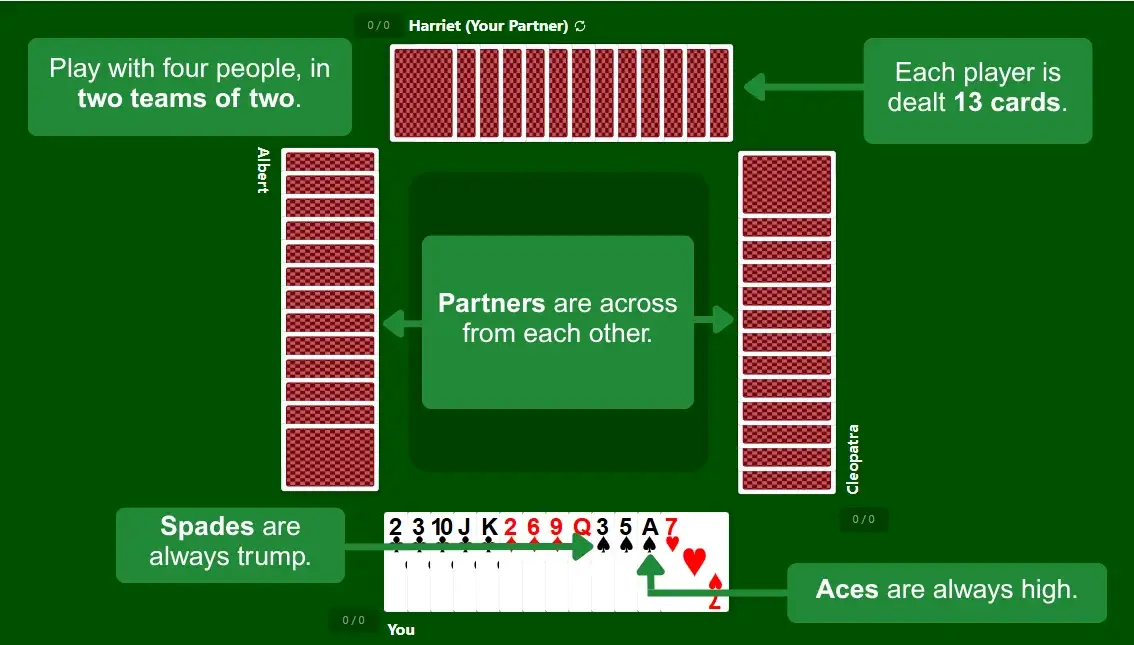
- Teams: Set up as two teams with each team sitting opposite to each other.
- Dealing: Each player is dealt 13 cards to start each round, leaving no leftover cards. Deal rotates to the left each round.
- Card rank: Cards are ranked with aces high.
- Trump suit: Spades is trump for the whole game.
Spades Rules
Each round (or hand) of Spades is broken into three phases. If you’re just learning, you can check out our detailed guides on how to play Spades and rules for scoring Spades.
Bidding
- Each player bids how many tricks they expect to win. Consider how many high-ranking cards you have that can cleanly take tricks, such as aces and kings, as well as how many spades might be able to trump other tricks. What you bid and how many tricks you win impact how your hand is scored for the team.
- Bids are combined to form the team’s contract. If one partner bids 3 and the other partner bids 4, the team must collect 7 tricks to satisfy their contract.
Playing Tricks
- Each player plays one card into the middle to form a trick. The player to the left of the dealer leads the first trick. For all subsequent tricks, whoever wins the trick leads the next trick, and players follow in a clockwise manner. After 13 tricks are played, you score the hand.
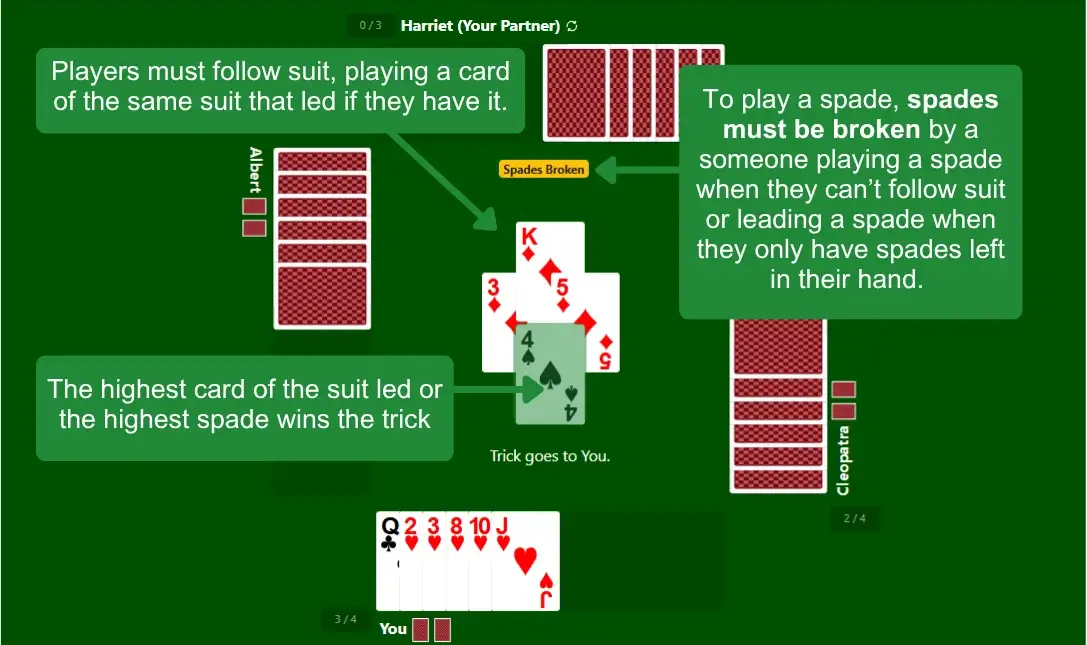
- Players must follow suit if possible. If you can’t play a card in the same suit that was led, you can play any card, including a spade.
- A spade cannot be led until spades have been broken. Spades can be broken either by someone trumping another suit or by someone holding only spades.
- The highest card of the suit that led or the highest spade played wins the trick. If a J♥ led, then whichever player plays the highest heart wins the trick, but if a player plays a spade, the highest spade played wins the trick.
Scoring
| Result | Points | Example |
|---|---|---|
| Tricks Won = Team Bid | 10 points for each trick up to the bid amount | Team bid 5 tricks and won 5 tricks = 50 points |
| Tricks Won > Team Bid |
10 points for each trick up to the bid amount 1 point for each trick (bag) taken over the bid amount |
Team bid 5 tricks and won 7 tricks = 52 points |
| Tricks Won < Team Bid | -10 points per each trick the team bid | Team bid 5 tricks and won 4 tricks = -50 points |
| Bagging Out (accumulating 10 bags) | -100 points and bag count resets | Team bid 5 tricks and won 7 with an existing bag count of 8 = -100 points (because 2 bags + 8 bags = 10) and a reset bag count |
| Nil Bid Won | 100 points | Team member bids nil and wins 0 tricks as an individual = 100 points |
| Nil Bid Lost | -100 points (no points for any tricks taken by the individual player who bid nil) | Team member bids nil and wins 2 tricks as an individual = -100 points and no points added for the 2 tricks won |
Spades Strategies
- Bid realistically. Aim to hit your bid rather than over- or undercommitting. Bags only give 1 extra point each, but as they accumulate, you risk a 100-point penalty. So consider how to guard your plays so you're not forced to take tricks you don’t need or give up ones you do need.
- Consider the bids of your opponents. What your opponents bid can inform your play. Between what they play and how many tricks they expect to take, you can discern which tricks they’re trying to avoid and which ones they’re hoping to take.
- Count spades carefully. Track how many spades are left to gauge when opponents can trump.
- Support nil bids. If your partner bids nil, take tricks that look like your partner may be forced to take to avoid the 100-point penalty.
- Use high spades wisely. Save your strong trump cards for critical tricks when opponents might lead suits you can’t follow.
- Avoid unneeded bags. If you're ahead on tricks, don’t take extra bags that could lead you to the bag-out penalty.
- Play your bid, not your hand. Once you commit to a bid, shape your play around meeting it rather than gambling for more unless you’re safe.
If you like multiplayer games, you can try playing Hearts, Whist, Euchre and Cribbage, and Gin Rummy.
