Loading...
Play Skat Online for Free
Skat Objective
To win Skat, you must be the player with the highest score after nine deals. You score points by winning your contract, which means you earn at least 61 of the 120 available card points by taking tricks as the declarer in a suit or grand game or avoiding all tricks in a null game.
How to Play Skat
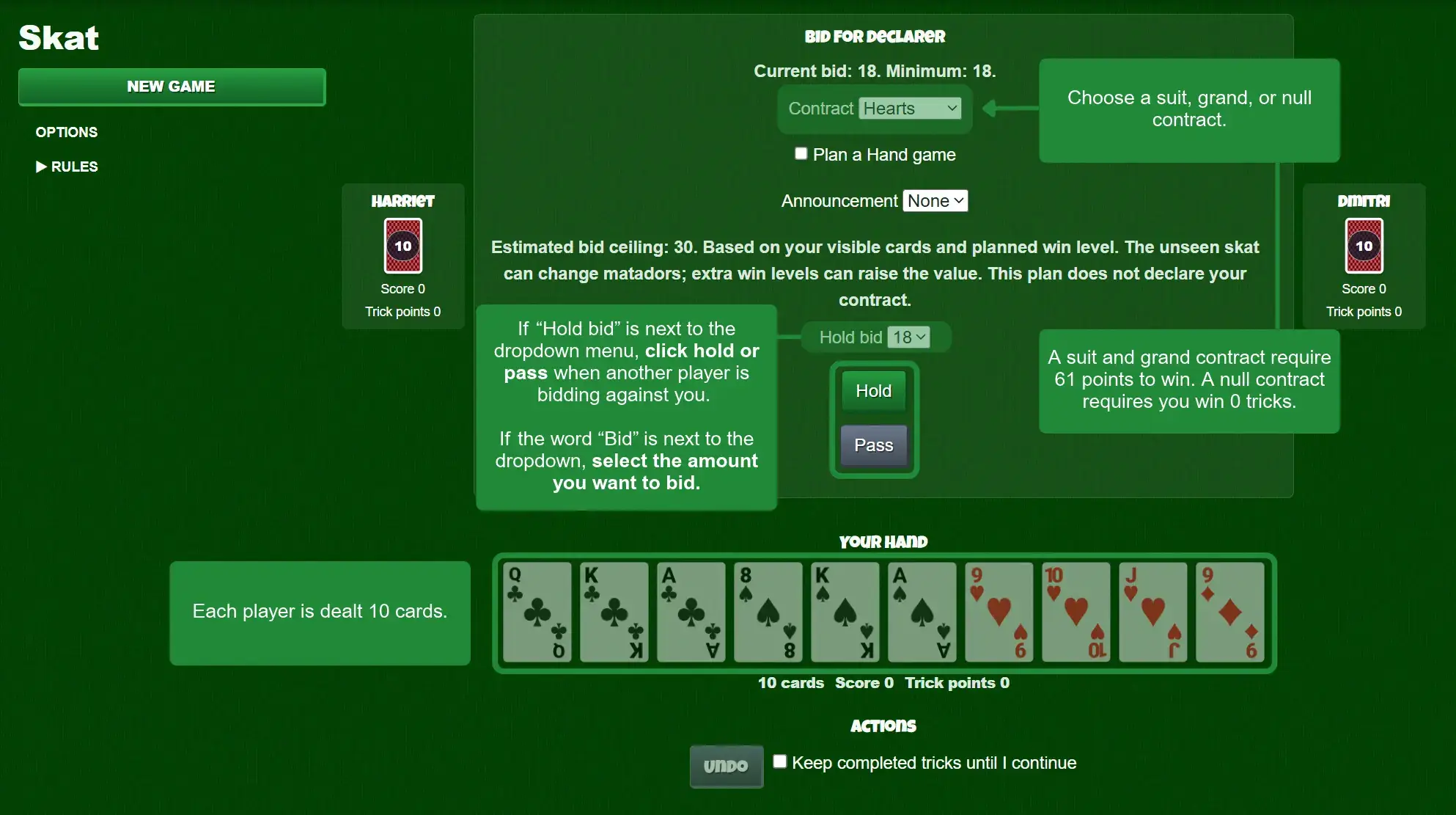
Skat uses a 32-card deck containing the 7, 8, 9, 10, J, Q, K, and A of each suit. Each player receives 10 cards, and the remaining two cards form the skat. Gameplay is broken into three phases: bidding to be declarer and selecting a contract, trick-taking play, and scoring. Seat positions play an important role and are named:
- Forehand: The player sitting left of the dealer
- Middlehand: The player sitting left of forehand
- Rearhand: The player sitting left of rearhand, which is the dealer
Phase 1: Bidding and Choosing a Contract
In Skat, bidding determines who gets to choose the contract. Unlike most trick-taking games, bids are calculated by your potential hand value, not how many tricks you think you can take, and not all players bid at first.
Before bidding, look at your cards and consider which contract best suits your hand. You might choose a suit contract (diamonds, hearts, spades, or clubs), Grand (where only jacks are trumps), or Null (where your goal is to win no tricks). Your likely contract helps you estimate how high you can bid.
Calculating Your Maximum Bid
Your maximum bid (called game value) can be calculated with this formula:
- Base value x (multiplier + 1)
Each part of the formula is broken out into its component parts below. Note that the +1 in the formula is added to your multiplier and simply refers to the game itself.
Each contract has a base value:
| Contract | Base Value |
|---|---|
| Diamonds (♦) | 9 |
| Hearts (♥) | 10 |
| Spades (♠) | 11 |
| Clubs (♣) | 12 |
| Null | 23 |
| Grand | 24 |
Multipliers refer to numbers earned from your matadors, game type, and achievements that are added together. Your multiplier is added to 1 (for the game itself), and then multiplied by the game's base value (see above) to determine its worth in bidding and scoring. This chart shows you all available multipliers.
| Multiplier | Value | Description |
|---|---|---|
| Matadors | +1 each | Consecutive top trumps held or missing, starting with the J♣ |
| Game | +1 | Automatically added to every suit or grand game |
| Hand | +1 | Playing without picking up the skat |
| Schneider | +1 | Winning with at least 90 card points (opponents have 30 or fewer) |
| Schneider Announced | +1 | Declaring Schneider before play in a hand game |
| Schwarz | +1 | Winning every trick |
| Schwarz Announced | +1 | Declaring Schwarz before play in a hand game |
| Ouvert | +1 | Playing with your cards exposed in a hand game |
Matadors are the consecutive highest trumps you have or are missing, beginning with the J♣. The trump ranking descends from J♣, J♠, J♥ , J♦, followed by A, 10, K, Q, 9, 8, 7 of the chosen suit. If you have the J♣ your matador count is called “playing with” and if you don’t have it, you’re “playing without.”
- If you have the J♣, you are playing with the top trump. Count consecutive top trumps you hold, starting with J♣. For example, if you have J♣ and J♠ but not J♥, you're playing with 2. Your matador count is 2, so your starting multiplier is 3.
- If you don't have the J♣, you are playing without the top trump. Count consecutive top trumps you are missing, starting with J♣. For example, if you have neither J♣ nor J♠, but do have J♥ and J♦, you're playing without 2. Your matador count is also 2, giving you a starting multiplier of 3.
If you choose a hearts contract, have J♣, J♠, A♥, 10♥, Q♥, and plan to play without skat (hand), then your maximum bid is 40:
- Base value: 10 (hearts base value)
- Matador (multiplier): 2 (you have the first two trump)
- Hand (multiplier): 1 (playing without skat)
- So, 10 x (3+1) = 40
The exception is null games. Null games follow fixed values.
| Null Game | Value | Description |
|---|---|---|
| Null | 23 | Play after picking up the skat. You must lose every trick. |
| Null Hand | 35 | Play without picking up the skat. You must lose every trick. |
| Null Ouvert | 46 | Play with your cards exposed after picking up the skat. You must lose every trick. |
| Null Ouvert Hand | 59 | Play with your cards exposed without picking up the skat. You must lose every trick. |
Bidding Rules
- Middlehand begins bidding against forehand. Middlehand announces a bid, typically starting at 18, the lowest possible bid value. Forehand can accept the bid or pass.
- If Forehand accepts, middlehand can announce a higher valid game value, such as 20, 22, or 23. Bidding continues until one player passes.
- Rearhand can bid against the winning bidder (the “survivor”). Rearhand can pass or announce a bid, which the survivor can accept or pass. Bidding continues until one player passes, with the winning bidder becoming the declarer.
- The declarer decides whether to use the skat. The declarer can pick up the two-card skat and discard two cards from their hand or choose to play hand, which means they don’t look at or use the skat cards. You receive a scoring bonus by playing hand.
Choosing a Contract
The declarer chooses the contract. Select clubs, spades, hearts, diamonds, grand, or null based on the strength of your hand. Your choice determines which cards are trump and how you must win the hand. The different types of contracts and their rules include:
- Suit: Choose clubs, spades, hearts, or diamonds as trump. All four jacks are the highest trumps, ranked J♣, J♠, J♥, J♦ from highest to lowest, followed by the remaining cards of the chosen trump suit, ranked A, 10, K, Q, 9, 8, 7. All non-trump suits follow that same ranking (A, 10, K, Q, 9, 8, 7). You need to score at least 61 points to win the contract.
- Grand: Only the four jacks are trump, ranked from highest to lowest as J♣ , J♠, J♥, J♦. All other cards belong to their regular suits and rank A, 10, K, Q, 9, 8, 7. You need to score at least 61 points to win the contract.
- Null: No cards are trump. All cards belong to their regular suits and rank A, K, Q, J, 10, 9, 8, 7. Unlike suit and grand contracts, you must avoid winning any tricks to win a null contract.
The declarer must fulfill the contract and take at least 61 trick points to win. Winning a hand involves meeting or exceeding 61 tricks points and having a hand value that meets or exceeds your bid.
Phase 2: Trick-Taking in Skat
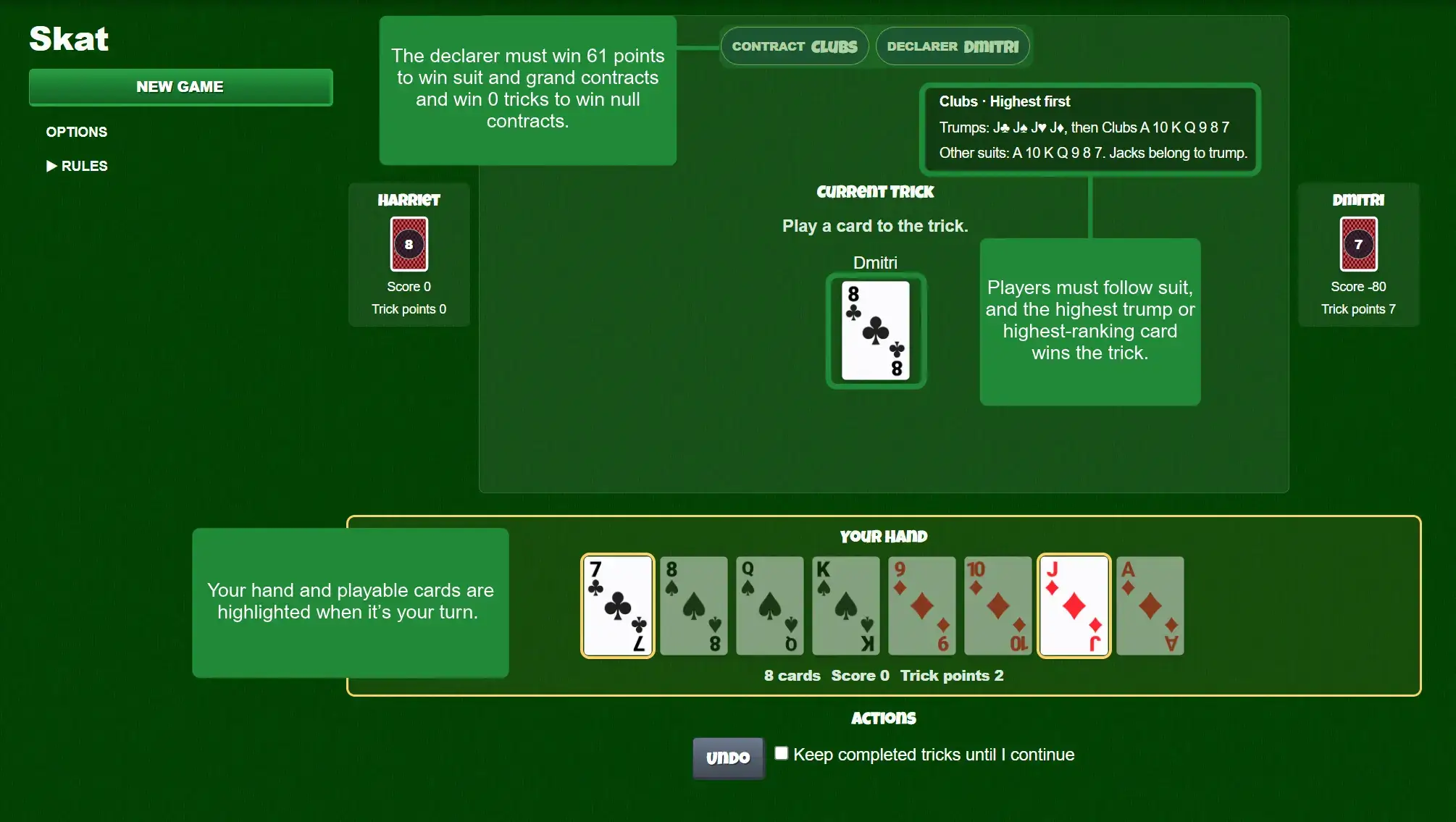
- The player to the dealer’s left (forehand) leads the first trick. For subsequent tricks, the trick winner leads the next trick.
- Players must follow suit. Players must follow the suit that led if they have it. If they don’t have a card in the lead suit, they can play any card, including a trump card.
- Whichever player plays the highest-ranking eligible card wins the trick. The winner collects the trick and leads the next one.
- The highest trump wins if any trump is played. Unless the contract is null, the jacks are also trump; if the contract is grand, only jacks are trump.
- Otherwise, the highest-ranking card of the lead suit wins. Cards are ranked in descending order, A, 10, K, Q, 9, 8, 7.
- Each player plays one card per trick until all 10 tricks have been played.
- Determine whether the declarer fulfilled their contract. In suit or grand, the declarer needs at least 61 card points. In null, the declarer must take no tricks.
- Score the hand. See the scoring section below.
- Continue playing until you’ve completed nine rounds. The player with the highest score wins.
Phase 3: Scoring
Card points determine whether you win your contract (with null as the exception), while your game value (the maximum you could have bid) determines how many game points you earn for each hand.
Card Points: Trick Scoring
You score card points during trick-taking play to secure a contract, but those points are only used to determine if you were successful. Those points aren’t used toward your overall score.
The points you need to win depend on the contract type:
- Suit or grand contract: The declarer needs at least 61 points to win a suit or grand contract. The two defenders win if they keep the declarer to 60 points or fewer. For example, if you capture four aces, three tens, and two kings, you have 82 card points (44 + 30 + 8), enough to win your suit or grand contract regardless of how many tricks you took.
- Null contract: Card points don't matter. You must lose all 10 tricks to win the contract. Taking even one trick means you lose the contract.
The 32-card deck contains 120 total card points as listed in the table below.
| Card | Points |
|---|---|
| Ace | 11 |
| Ten | 10 |
| King | 4 |
| Queen | 3 |
| Jack | 2 |
| Nine, eight, seven | 0 |
Game Points
After all ten cards are played, game points are calculated based on the declarer’s game value and whether they made their contract.
- If the declarer made their contract, they receive their game value (the maximum they could have bid), and the defenders get 0.
- If the declarer doesn’t make their contract, they must subtract double their game value from their score.
- Note: The declarer’s bid may be lower than their actual game value, but they still score their game value, not their bid value.
See the Bidding section for how to calculate game value as it’s the same as your maximum bid.
Skat Strategies
- Choose a contract that fits your hand. If you have several jacks and high-ranking cards in one suit, consider choosing that suit as trump. If you have the J♣ and J♠ and a couple of aces and tens, grand may be a better option. If you have mostly low cards and few cards likely to win tricks, consider null.
- Pay attention to your jacks. Jacks are the most powerful trumps in suit and grand games, so knowing which ones you hold helps you estimate how many tricks you can control. For example, holding J♣ and J♠ gives you the two highest trumps, making it harder for your opponents to win tricks with their trumps.
- Protect your aces and tens. Aces and tens are worth 21 points together, so you don't want to lose them unnecessarily. If you hold A♠ and 10♠, for example, consider whether your opponents can still trump spades before leading those cards.
- Use trump to control the game. If you have several strong trumps, leading them can force your opponents to play theirs. After opponents run out of trump, your high cards in other suits may be safer to lead. However, avoid using all your trumps too early if you still need them to capture valuable cards.
- Track which suits opponents can't follow. If an opponent doesn't follow a lead suit, you know they have no remaining cards in that suit. They may be able to trump that suit later, so be careful about leading valuable aces or tens when you know an opponent is void in that suit.
Skat is a fun trick-taking game where every hand can switch up gameplay, allowing you to score big when you play your cards right. If you enjoy trick-taking games, you might also like Spades, Euchre, and other Solitaire games, all of which you can play on Solitaired for free!
